Development · Guide
The history of web development: from static HTML to cloud and AI
Quick summary — The History of Web Development: From Static HTML to Cloud and AI

- Author:
- Misha Gavura
- Published:
- Reading time:
- 5 min
- Views:
- 5
- Likes:
- 0
- Summary
- Web development went from hand-written HTML in 1991 to server languages, CMS platforms, frameworks, cloud hosting, no-code tools, and AI-generated code. One direction runs through all of it: the barrier to entry kept falling — what once needed a team can now be started by one person with an AI assistant. Ease of building never produced reliability on its own: a site that survives load, growth, and maintenance still needs engineering decisions behind it.
Table of contents
Key takeaways
- Web development went from hand-written HTML in 1991 to server languages, CMS platforms, frameworks, cloud hosting, no-code tools, and AI-generated code.
- One direction runs through all of it: the barrier to entry kept falling. What once needed a team can now be started by one person with an AI assistant.
- Ease of building never produced reliability on its own. A site that survives load, growth, and maintenance still needs engineering decisions behind it.
The Web Began With Static Files
Tim Berners-Lee published the first website in 1991. Pages were HTML files: text, headings, links. Everyone saw the same thing, and nothing responded to the user.
Updating one line meant editing the file and uploading it to the server again. Web development was writing markup by hand.
Everything after that is one story: sites got more capable, and building them got easier. How search evolved alongside it is a separate line worth reading next to this one.
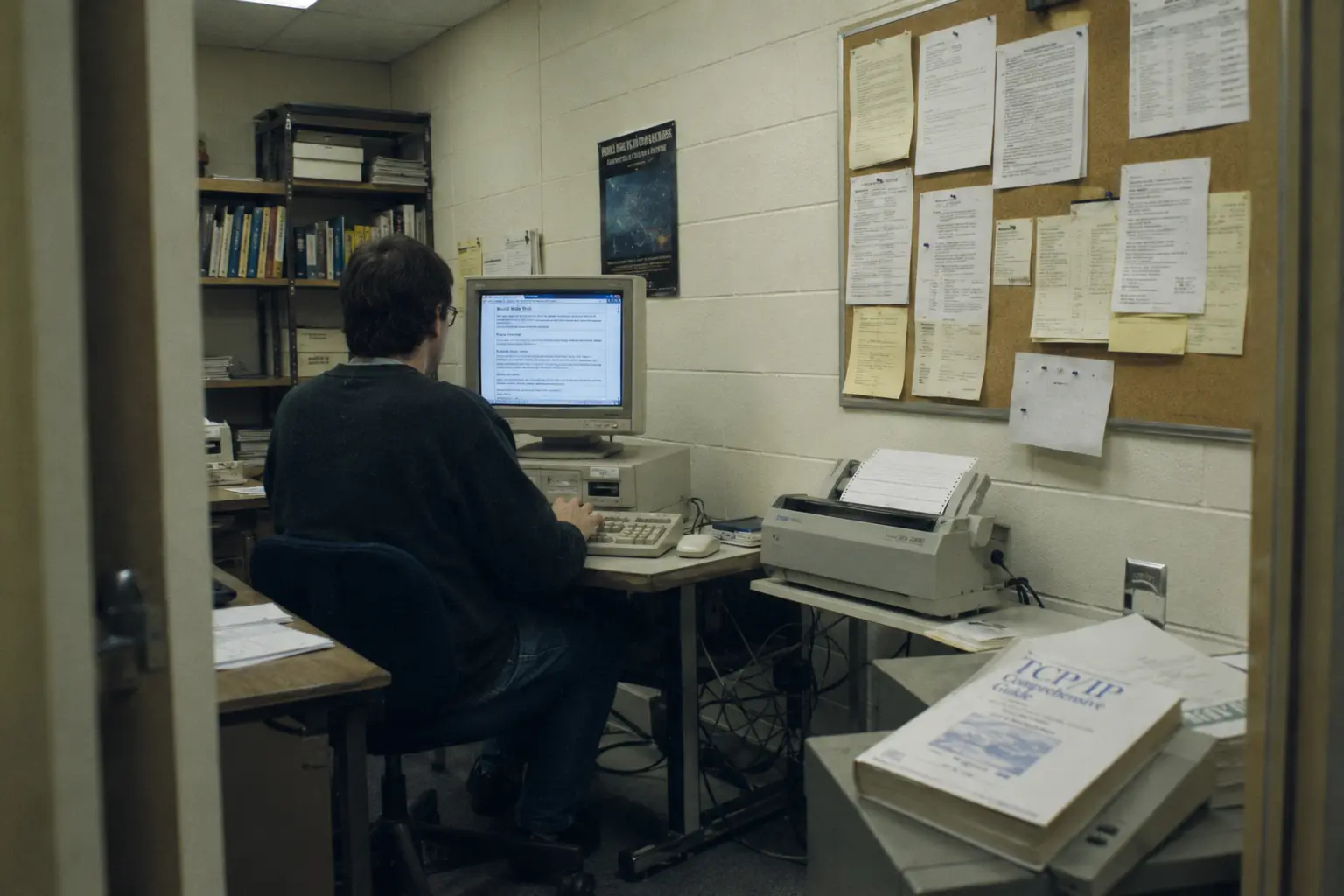
Timeline of Web Development
| Year | What appeared | What it changed |
|---|---|---|
| 1991 | HTML | Static documents. Everyone saw the same page. |
| 1995 | JavaScript, PHP | Pages responded to actions. Servers built pages per request. |
| 2003 | WordPress | People without code could run a site. |
| 2006 | jQuery, AWS | Cross-browser scripting. Rented infrastructure. |
| 2007 | iPhone | The phone became the primary device. |
| 2009-2013 | Node.js, React | Applications ran in the browser. |
| 2013+ | Webflow, no-code | Sites assembled visually, without code. |
| 2021-2022 | Copilot, ChatGPT | The machine started writing the code. |
JavaScript and PHP: The Page Comes Alive
JavaScript arrived in 1995 and ran inside the browser. Pages could respond to clicks, validate forms, and change content without reloading.
PHP arrived the same year and changed the server side. A page stopped being a file and became a result the server assembled per request, pulling data from a database.
Accounts, carts, dashboards, and saved forms became possible. The web moved from something you read to something you use. Both required real programming, so it stayed the territory of specialists.
CSS and the Browser Wars
CSS arrived in 1996 and separated styling from content. For developers this mattered because markup got lighter and maintainable.
The practical cost of that era was browser incompatibility. The same code behaved differently in each browser, so developers wrote several versions of the same thing. jQuery in 2006 existed largely to smooth that over.
What CSS did to design is a bigger story: how sites looked while this happened.
WordPress and the First Collapse of the Barrier
WordPress launched in 2003 and opened the web to people who did not code. The system handled the technical layer. The owner added pages, wrote text, and picked a theme.
An ecosystem of plugins followed, giving a site features nobody had to build. What used to require a developer became an afternoon of work.
The effect was enormous, and it set a pattern that has repeated ever since. Every time building gets easier, more sites get built, and more of them get built without understanding what is underneath.

Frameworks: Complexity Comes Back
As sites grew into applications, hand-writing everything stopped scaling. Frameworks appeared to carry the routine and impose structure.
Node.js in 2009 moved JavaScript to the server. React landed in 2013 and made it practical to run a full application in the browser, updating only what changed.
Capability multiplied, and so did the number of tools a developer had to know. Building complex sites became an engineering discipline again, now with much sharper instruments.
Cloud and No-Code: The Barrier Falls Again
AWS launched in 2006 and removed servers from the owner's problem list. Infrastructure became something you rent and scale, not something you buy and rack.
Then no-code tools like Webflow and Bubble let people assemble sites and apps visually, with little or no code. An entrepreneur could ship something in an evening.
The same pattern repeated. Lower barrier, more sites, and a wider gap between what looks finished and what is actually built to run.
The AI Era: The Machine Writes the Code
GitHub Copilot arrived in 2021 and ChatGPT in late 2022. Describe what you want in plain language and get working code back. Andrej Karpathy named the resulting habit vibe coding in 2025.
The barrier is now at a historic low. Someone who cannot program can produce a working prototype by explaining the idea. For prototypes, internal tools, and testing a hypothesis, this is a real breakthrough.
Generated code still carries the same engineering questions it always did: architecture, security, data model, error handling, and whether the next person can maintain it. Those questions do not disappear because the code arrived faster.
AI shifts the role rather than removing it. The machine writes. The human owns the architecture, the review, and the reliability.

Fast to Build Is Not Built to Last
Thirty years, one direction: building got easier at every step. That is a good thing, and it is not the whole picture.
The question for an owner is no longer whether a site can be built fast and cheap. It can. The question is what happens to it in month six.
What separates a fast build from a durable one:
- The architecture survives a growing catalog and a traffic spike.
- Another developer can read the code and continue the work.
- Integrations and data flows are documented, not improvised.
- Security and performance were decisions, not defaults.
- The stack is one the market can staff.
That difference does not show in a demo. It shows in operation. We build stores as engineers, using modern tools including AI, with the architecture reviewed by people. Toronto, Canada.
Blog search
About the author