Development
5 years, 180+ Shopify stores What we learned
Quick summary — 5 years, 180+ Shopify stores: what we learned about why stores don't convert
- Author:
- Misha Gavura
- Published:
- Reading time:
- 8 min
- Views:
- 0
- Likes:
- 0
- Summary
- EVDEV, a Shopify agency in Toronto founded in September 2021, has launched 180+ Shopify stores. Our audit of 5,410 stores found only 4.7% passed 8 basic conversion checks; most stores need a few fixes, not a redesign.
In this article · 12 sections
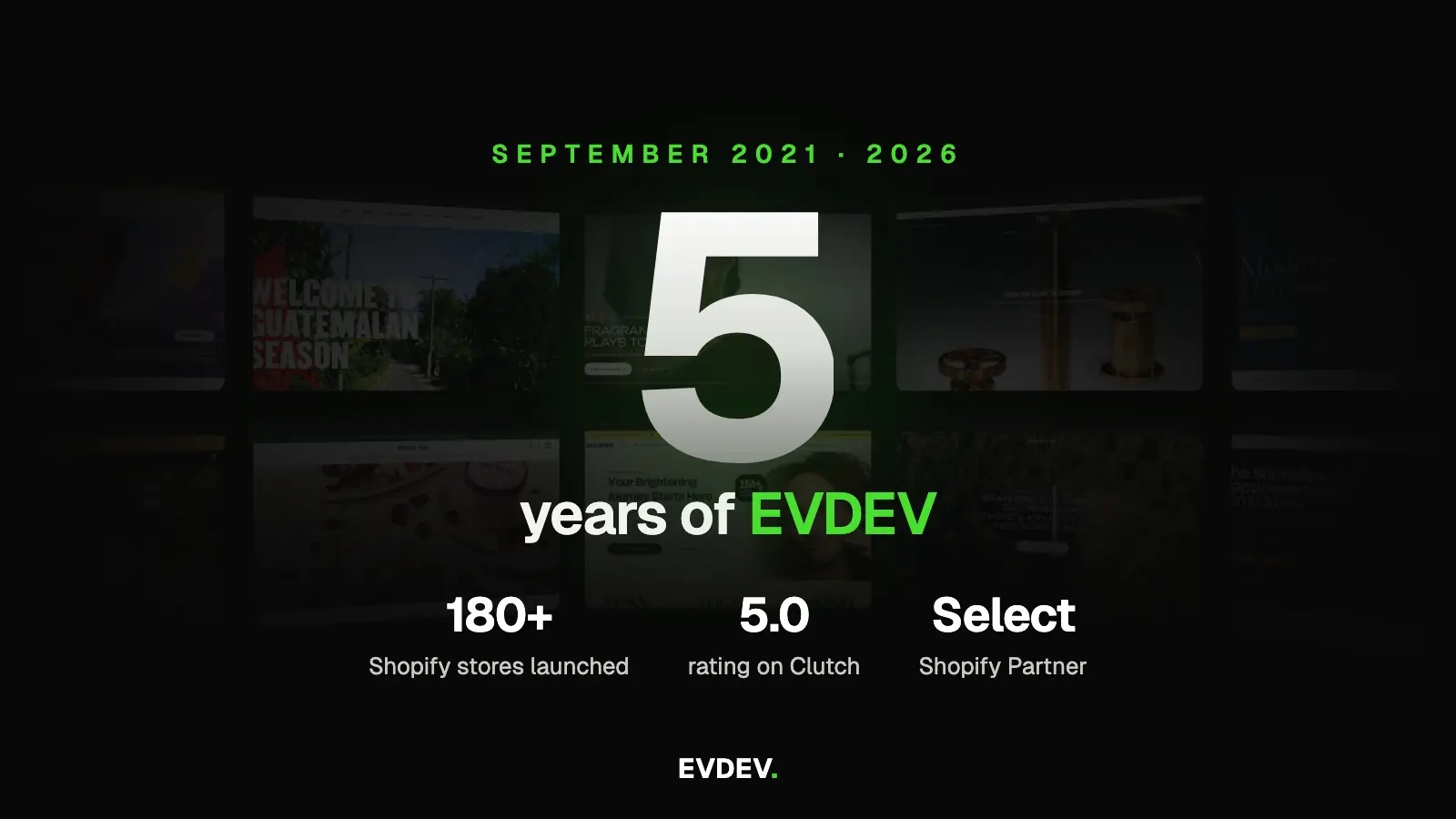
EVDEV opened in September 2021 with one goal: build Shopify stores that look premium and actually sell. Five years and 180+ launched stores later, this is what we did, what we got wrong, and what we learned about why Shopify stores do or don't convert.
Key takeaways
- 180+ Shopify stores launched since September 2021, from a 12-person team in Toronto.
- Most stores don't fail on design. In our audit of 5,410 Shopify stores, only 254 (4.7%) passed all 8 of our basic conversion checks.
- The average store had 2.72 fixable issues, and 70.7% had three or fewer, so most stores need a few targeted fixes, not a full rebuild.
- The fixes that move sales are boring: add-to-cart within reach on a phone, a free-shipping prompt, a fast homepage, and shipping, returns and reviews next to the price.
- The best way to choose a Shopify agency is to ask for live stores, a fixed price and the person who will actually build your store.
Five years in numbers
These are the numbers we stand behind as of November 2026.
| What | Number |
|---|---|
| September 2021 | EVDEV founded in Toronto |
| 180+ | Shopify stores launched |
| 12 | People on the team |
| 5,410 | Shopify stores in our 2026 conversion audit |
| 5.0 | Rating on Clutch |
| Shopify Select Partner | Partner tier with Shopify |
| Top Rated Plus | Status on Upwork |
| 2 business hours | Reply time to new enquiries |
Before EVDEV, our team also delivered digital work for NATO SPS, UNICEF and PepsiCo programmes. That experience with large, careful clients shaped how we run every Shopify project: written scope, fixed price, weekly updates.
How the work changed, year by year
2021: the first store and a 3D box configurator
Our first case study is still one of the most technical. For 105 Packaging we built a custom box configurator on Shopify with a 2D dieline, a live 3D preview and custom pricing logic. It taught us early that Shopify can do far more than a theme demo suggests, if the build is planned around the product.
2022: Shopify Plus and headless
In 2022 the projects got bigger. VIGO is a Shopify Plus B2B store with more than 12,000 products, some carrying 140+ metafields. Synofit went headless on Next.js with the Storefront API and Contentful. We learned when headless is worth it and, just as often, when it isn't.
2023: custom themes that carry real volume
DripClub runs on a custom Liquid theme built for a brand doing 350,000+ sales a year. Duyu Care was another headless Next.js build. Both made the same point: speed and clarity on mobile matter more than any animation.
2024: brands, drops and Canadian retail
2024 brought more brand work: M.Fraise, a Canadian creator loungewear brand that sells in limited drops, Sleep Shop, Enovix, Son of Oak and Mind the Skin. Drops taught us to make choosing a size and colour fast, because a slow product page loses the sale before stock runs out.
2025: big catalogues, migrations and CRO
myWork Supplies is a Shopify Plus B2B store with about 120,000 SKUs and catalogues set per company. Nugevia moved from a headless Hydrogen app back to a standard Shopify theme, rebuilt as 50 custom Liquid sections so the brand's own team could edit it. Happy Staffy Co was a conversion project from homepage to cart. This is the year CRO became a core part of how we build, not an add-on.
2026: ERP, B2B and a 5,410-store study
This year we built Weathervane Hill on Shopify Plus with product data synced from an Acumatica ERP, moved Ästhetik from Magento to Shopify, and built a B2B store for five trades for LAND Helmets. We also published our audit of 5,410 Shopify stores, the largest piece of research we have done, which turned five years of patterns into numbers.
Why most Shopify stores don't convert
After 180+ builds and a 5,410-store audit, the answer is rarely "the design isn't pretty enough". When a Shopify store isn't converting, it is usually one of a few practical gaps that cost shoppers time or confidence at the moment they decide.
In our July 2026 audit, the most common gaps were:
- Add-to-cart below the first phone screen on the product page: up to 71.3% of stores.
- No free-shipping threshold message: 65.1%.
- A slow homepage from images that never lazy-load: 37.7%.
- No shipping, returns or guarantee copy near the buy button: 37.1%.
Most Shopify stores are three fixes away from clean, not a redesign away. 70.7% of the stores we audited had three issues or fewer.
A stricter re-measure in September 2026 flagged fewer issues, so read the July figures as upper bounds. The full method and every check are in the study.
The 7 Shopify store mistakes we fix most often
- Add-to-cart out of reach on mobile. Fix: a sticky buy bar that keeps the button on screen.
- No reason to add one more item. Fix: a free-shipping progress bar in the header and cart drawer that counts down the spend left.
- A heavy homepage. Fix: lazy-loaded images, fewer apps and sections that load only when needed.
- Doubt at the price. Fix: shipping times, returns and a guarantee right next to the buy button.
- No social proof where it counts. Fix: reviews on product cards and product pages, not only on a separate page.
- Filters that don't match how people shop. Fix: filters built from real product data, like the scent, size or fabric filters in our case studies.
- A store the team can't edit. Fix: sections the brand can change in the theme editor without calling a developer.
How many Shopify stores are actually successful?
Nobody outside Shopify can measure revenue across millions of stores, and we don't pretend to. What we can measure is the build side. Of the 5,410 stores we checked, 254 (4.7%) passed all 8 of our basic conversion checks, and the average store had 2.72 issues. That tells us most stores leave sales on the table for reasons that are cheap to fix.
What changed on Shopify between 2021 and 2026
- Online Store 2.0 (2021) made sections available on every page, which is why stores can now be edited without code.
- Hydrogen (2022) gave brands an official headless option. We use it when a brand truly needs it, and we have also moved brands off it.
- Checkout extensibility (2024) replaced checkout.liquid. Checkout changes now run as checkout UI extensions and Shopify Functions.
- Shopify Scripts stopped running on June 30, 2026. Discount and shipping logic now has to be rebuilt as Functions or apps.
- Horizon themes (2025) became our default starting point for many custom builds.
- AI search now matters too. Shoppers ask ChatGPT and Google's AI answers which store to buy from, so product data and structured data have to be clean.
What a Shopify partner agency actually does
A Shopify partner agency designs, builds, migrates and improves stores on Shopify for other businesses. Shopify groups its partners into tiers, and Shopify Select Partner is a tier Shopify grants to agencies with a track record of launched stores and merchant results. For a merchant, it means Shopify has looked at the agency's work, not only its marketing.
How to choose a Shopify agency: what we would ask
- Show me live stores like mine. Not mockups. Open them on your phone and try to buy something.
- What is the fixed price, in writing? Hourly estimates on a store build tend to grow.
- Who will actually build it? Ask to meet the person, not only sales.
- What happens after launch? Look for included support and a plan for updates.
- Who owns the code and the store? You should, from day one.
- How will you measure success? Speed, conversion rate and organic traffic are measurable. Promises of a guaranteed revenue lift are not.
For a deeper guide to cost, see how much it costs to hire a Shopify expert and Shopify pricing in Canada.
What's next for EVDEV
The next five years will be shaped by Shopify Plus B2B, AI search and accessibility. We will keep publishing research like the 5,410-store study, keep building in Toronto for brands across Canada, and keep the same rules we started with: a fixed price before work starts, a co-founder on every project, and stores you own.
Thank you to every brand that trusted us with their store since 2021. If you are one of them, we would love to hear what the next five years look like for you.
Frequently asked questions
Why is my Shopify store not converting?
In our audit of 5,410 Shopify stores, the most common reasons were an add-to-cart button below the first phone screen, no free-shipping prompt, a slow homepage, and no shipping, returns or reviews near the price. Fixing those few gaps usually matters more than a redesign.
What are the most common Shopify store mistakes?
Add-to-cart out of reach on mobile, no free-shipping message, heavy homepages, missing trust copy at the price, reviews hidden away, filters that don't match how people shop, and stores the team can't edit without a developer.
How much does it cost to hire a Shopify expert?
At EVDEV, fixed-price Shopify builds start from CA$3,000, store design from CA$2,500 and migrations from CA$2,000. Larger custom and Shopify Plus builds are quoted at a fixed price after a free call. Our Shopify expert cost guide covers typical ranges.
What does a Shopify partner agency do?
It designs, builds, migrates and improves Shopify stores for other businesses, from a first store to Shopify Plus B2B with ERP integrations, plus SEO and conversion work after launch.
What is a Shopify Select Partner?
Shopify Select Partner is a tier in Shopify's partner program for agencies with a proven record of launched stores and merchant results. EVDEV is a Shopify Select Partner.
How do I choose the right Shopify agency?
Ask to see live stores like yours, get a fixed price in writing, meet the person who will build your store, check what support is included after launch, and make sure you own the code and the store from day one.
Sources and how we checked
- EVDEV audit of 5,410 Shopify stores, July 2026, with the September 2026 re-measure
- EVDEV case studies, each written from the live store and project records
- EVDEV on Clutch
- Company facts (founding date, team size, stores launched) from EVDEV's own records, November 2026
Keep reading
- Lightspeed vs Shopify for Canadian retailers (2026)13 min
- Shopify vs WooCommerce (2026): what each really costs and when WooCommerce wins15 min
- Shopify Acquires Tailwind: What Every Shopify Acquisition Tells You About Where Shopify Is Going11 min
About the author